




Probably our most valuable resource in developing sustainability is people. People will not only learn the new ways and stuff of sustainable living, they will learn social tools. Social interaction and support is what allowed human beings to prosper against the ice age odds, working together we accomplished much more than as individuals.
Then as now, when faced with survival odds it is our collaboration and mutual support that makes the difference, and communication is key. People can learn and teach practical skills for communication. There exist systems and structures for collaborative communication which can be taught and practiced. Click here for recommended reading.
Teaching partnership skills to children (and their parents), will enhance the likelihood of a productive social outcome, and enhance the likelihood of personally satisfying relationships. Riane Eisler has done much work in this regard, and identifies the distinctions between partnership and dominator models of relations, and identifies steps for personal, social, and educational change based on partnership models. see Center for Partnership Studies.
Neuroscientists tell us that we have in essence two brains. One on the left which is analytical and reductive- it looks for the differences, finds a reason to distinguish details, keeps track of time, and declares self as being separate.
The brain on the right by contrast is holistic and constructive- it looks for the similarities, finds a reason to make connections, experiences timelessness, and recognizes itself as part of all that is. Dr. Jill Bolte Taylor will tell you more. Click here to tune in to Jill on TED Blog.
Leonard Shlain, also a neuroscientist, looks at how right/left brain differences have affected human cultures in the past and present. He correlates the effects of widespread literacy (reading/writing technology) adoption in societies with cultural upheaval and behaviors primarily motivated by fear, (genocide, inquisitions, etc.). He identifies the left brain as the seat of fear, and how reading/writing as primarily a left brain exercise feeds a fear cycle. He also identifies that our cultural social software programming has been promoting what is essentially left brain dominance and the violent social legacy thereof. Click here to read more.
Shlain and Taylor identify the right brain as the seat of love, and the counter balance to left. Both of them indicate that developing right brain practices can help to balance us personally and socially, and unlock tremendous creative potential.
To exist in this modern world at our greatest human potential requires facility between the brains, and the recognition that we can choose of fear or love in every moment.
The right brain can steer the ship to peace, love and harmony. The left brain can work out the details, avoid the reefs and rocks, but left on its own, in charge, will steer a course to conflict.
The right stuff is that which puts us in a right brain active mode, thus strengthening the neural pathways of that brain, and the likelihood of its predominance for the benefit of the person and their social whole. The right stuff is that which makes us one.
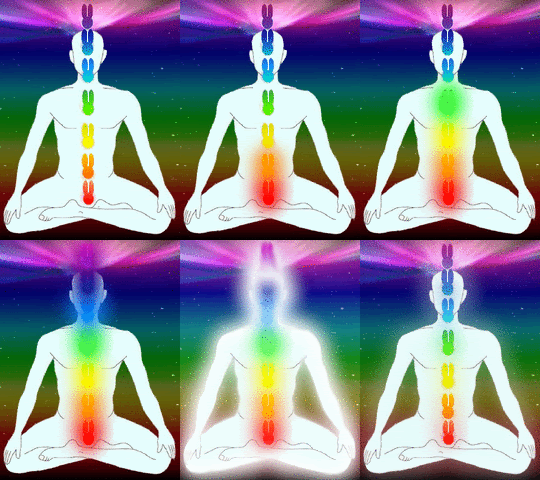
Right brain stimulating activities include toning, singing, chanting, music making, meditation, dancing, drumming, drawing, imagining, talking and telling stories. Whole brain engagement is probably the reason for the “Mozart effect”, whereby students excel when they study with Mozart playing.
We also recognize the importance of cultivating these skills in ourselves and our children, and making them an important part of daily activity and sacred ritual. That adds meaning to our lives as human beings, and helps us to be healthy, happy, and whole.
Harmony & Health has sponsored or partnered many right brained events and workshops.
© 2007-2010 Harmony and Health Foundation.